One might define spirituality as consciousness and vice versa. Why? Well, the Daoists claim that the dot of creation, the dot within the void, was spirit. If we follow that train of thought, that’s perhaps one reason these two terms are interchangeable. But others frameworks suggest that consciousness and spirituality are related but not interchangeable: consciousness refers to awareness or sentience, while spirituality refers to how that awareness orients toward meaning value, and “something more” than the merely material.
“The reality today is that we are all interdependent and have to co-exist on this small planet. Therefore, the only sensible and intelligent way of resolving differences and clashes of interests, whether between individuals or nations, is through dialogue.”
“We humans are social beings. We come into the world as the result of others’ actions. We survive here in dependence on others. Whether we like it or not, there is hardly a moment of our lives when we do not benefit from others’ activities. For this reason it is hardly surprising that most of our happiness arises in the context of our relationships with others.” ― Tenzin Gvatso, 14th Dalai Lama
It seems obvious to me that the people of the world are not all operating from the same level of consciousness. Let me offer this concept, first written about by Jane Roberts, and later, I’ll fill in the details in the chapter, Afterlife.
Simply understood, the territories of consciousness can be thought of as multidimensional and layered, encompassing both the known waking awareness and deeper, vaster realities that underlie physical experience. At the simplest level, consciousness was seen as composed of basic “units of consciousness” (or CU’s), which form the building blocks of all physical matter, perception, and even the fabric of space itself. These units are inherently creative, self-aware, and interrelated, meaning every aspect of reality—from matter to thought—arises from conscious interaction and intent.
Jane Roberts also outlined “inner senses,” faculties of consciousness beyond ordinary physical perception. These inner senses allow individuals to access deeper subjective experience, intuitive knowing, direct empathy, and an expanded understanding of time and reality. The territories of consciousness described by Roberts span:
• Everyday waking awareness
• Dreaming and altered states
• Deeper subjective realms accessible through inner senses
• Larger fields of nonphysical, creative consciousness that interact to shape both personal and collective reality
Simply put, the territories of consciousness for Jane Roberts (and the entity she channeled, Seth) begin at ordinary thought and sensation but extend into far-reaching, multidimensional realms where physical and nonphysical realities meet and co-create.
Resource: The Seth material by Jane Roberts.
Speaking of altered states of consciousness, this supports parts of recorded conversations and lectures I’ve listened to of Terence McKenna. He was the ethnobotanist who said we could all have a deeper relationship with the divine via experimenting with substances such as ayahuasca, marijuana, and psilocybin from mushrooms. For more regarding this, circle back to the chapter, Botany. Now, I wonder what Jane Roberts was ingesting to wake up her inner senses or tap into some faculties beyond the everyday consciousness.
The rest of this chapter focuses on spiraling on the spiritual, interconnectedness across traditions, how mystical traditions merge, The Holy Bible, proving Bible authorship, The Tao Te Ching, The Book of Mormon, Lesson from the Maya, comparing the numerics, about scholars and rigor, spiritual deepening, oneness, and fractals of Omniscience.
Spiraling on the Spiritual
What lies beyond our human body could be considered spiritual. Think of spirituality as everything we are that is outside of our consciousness, mind, and body. Spirituality is the study of our soul and spirit. I often muse on the words, inspire, spirit, spiral, and spire (of a church). And then I meditate on the spiral of a snail’s shell, a seashell, ocean waves, and ferns.
Revisiting the Spiritual Layer of Consciousness
As presented much earlier in this book, I love to follow the work and observations of thinkers such as Viktor Schauberger and Terence McKenna. I find the simplicity of the spiral pattern in nature to be one of the most relaxing and consciousness expanding visual cues we have.
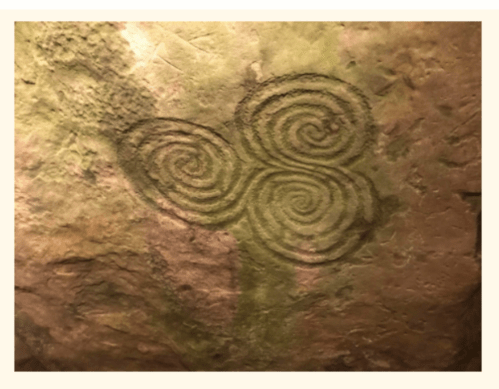
The way I see it, spirituality beautifully weaves together breath, being, and the spiral patterns of nature; etymology and symbolism support something that I simply intuit. Spirituality can be seen as the exploration of everything we are beyond the surface layer of body, thoughts, and everyday consciousness, while remaining deeply patterned by the same living sacred geometries that shape seashells and galaxies. And the saints of old must have agreed as I’ve found spirals at sacred sites dating back thousands of years.
Mapping Interconnectedness
As presented in the chapter, Layers of Consciousness, any map we might draw to illustrate our interconnectedness with the surrounding infinite field would need to include all of the layers — not simply circular or spiral rings, but it would need to include the space in which they exist. Not an easy task. It might be akin to drawing a rainbow to include the seeming invisible boundaries between each color.
Interconnectedness in and around Physics (universal consciousness and divine essence), that encompasses the Spiritual (universal consciousness and divine essence), that imbues the Biological (anything that breathes, uses vibration, frequency, or language to communicate), and thrives on Social (interacts via language models, cultures)
A drawing representing interconnectedness could be structured as a nested, multi-layered diagram or a network of flowing connections, using visual metaphors to link the concepts. The core idea is that everything is fundamentally linked, from the universal scale to the social. My mind tends to better grasp large complex subjects when I can draw them out on a piece of paper. However, I’m not a trained illustrator or artist, so I’ve asked AI to help me with this task.
If one could simply map out a drawing of Interconnectedness, visualized by using structural elements it might look a bit like this:
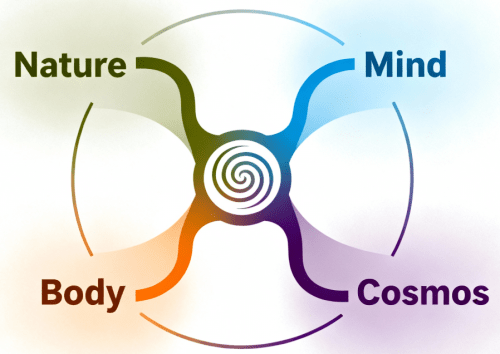
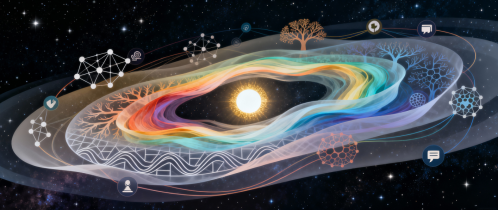
Taking it a step further, our diagram could be represented by a unified field or a cosmic web/tree of life design that permeates all other elements.
Layers, Levels, Doses, and Degrees of Universal Existence
In the last several years of exploring what it really means that We Are All Connected, a simple framework has kept returning to me: life unfolds in layers, levels, doses, and degrees. Often, we can understand the vastness of the macro by looking closely at the micro and then applying those patterns from one scale to another. It is not perfect in every circumstance, but it comes surprisingly close.
When I picture universal existence, I see an outermost layer like a vast, swirling galaxy or quantum field, with subtler layers nested inside—physics, biology, society, and spirit all interacting. In that imagined map, every part affects the others. Nothing can be removed without changing the whole, which is a beautiful visual reminder that nothing and no one truly exists in isolation.
The Spiritual Layer would be interwoven with physics, represented by glowing light, a central “divine essence” or “universal consciousness” symbol (e.g., a bright, radiating light source or a sacred geometry pattern). This suggests that consciousness is a fundamental aspect of reality, as some theories propose.
The Biological Layer would display a the universal container, focused on life on Earth. Use green, earthy tones, and organic shapes (cells, DNA strands, natural landscapes). Highlight living organisms that “breathe” with small illustrations of animals and plants. Incorporate subtle icons representing vibration, frequency, and language (sound waves, brain synapses). This demonstrates how biological systems process information and connect through various means.
The Social Layer — to represent the inner, dynamic layers that interact with the biological and spiritual layers, using more defined human figures, networks, and communication lines. Colors can be diverse to represent different cultures. This layer would show interaction points and a flow of information between individuals. We want to represent the various languages of the main cultures with flowing lines of text illustrating how shared narratives and information processing shape social power and interaction.
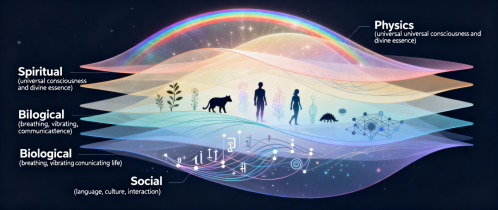
While it may seem impossible to show the relationships between the layers with gradient color transitions this might be the closest AI could get to it in a 2D model. I submit that our planet, Mother Earth, Gaia, is the 5D representation of such a model where each of us can live as individuals, yet connect with other humans, plants, animals, and minerals in such a way as to learn, grow, and understand via feedback loops and come to a knowledge of our universe. Our senses only allow us to see, hear, smell, taste, and touch a portion of our environment, but every particle, thought, and social interaction, depending upon how and when it is observed can give us a clue as to the unbroken, undivided web of reality.
Any drawing of this nature should present a unified, organic whole, where no single part can be removed without affecting the entire structure, visually emphasizing that “everything in existence is fundamentally linked, with nothing existing in isolation.” And that would be quite the tall order for any illustrator or artist in my humble opinion.
We’ll revisit the spirals in the last section, Spiral Ascension Path, at the end of the Afterlife chapter.
Interconnectedness Across Traditions
Growing up in an interfaith family—Latter-day Saints on one side and non-church going Methodist on the other—and watching my own family branch into new traditions (my eldest granddaughter is a quarter Jewish), has required a different kind of spiritual flexibility. Daily life has meant sitting at the same table with people who hold strong, sometimes conflicting beliefs, and still choosing to love each other.
Eventually, I came to understand that every tradition arises from a particular worldview. Whether or not I resonate with an entire system, I can still notice which teachings genuinely nourish my spirit and soul, and which do not. And I can also choose, at times, to step outside all systems and simply rest in direct experience. Perhaps it is enough, to allow that there may be truth in the saying, “Every person is connected to all others in God’s plan.”
Perhaps it’s enough to allow for the possibility of truth in the saying, “Every person is connected to all others in God’s plan.”
Theme of Interconnectedness and Unity
When we begin to read across the world’s sacred texts, one theme rises again and again: interconnectedness. The language changes, the symbols differ, but the underlying message is remarkably consistent—that all life, existence, and spirit are woven into one living whole.
In the Bible, for example, Paul’s image of many members forming “one body” points to a unity in diversity, where each person is a vital part of a greater living presence. The Tao Te Ching speaks of the Tao flowing everywhere, giving rise to all things without claiming ownership. Buddhist teachings describe dependent origination and Indra’s Net, where every jewel reflects every other, mirroring the truth that nothing exists in isolation.
The Bhagavad Gita affirms that seeing the same divine presence in all beings dissolves the illusion of separateness. The Quran speaks of a single soul from which many men and women arise, grounding human diversity in a shared origin. Indigenous and shamanic traditions remind us that harming one part of creation affects the whole spiritual ecology. Even the Golden Rule, found in multiple faiths, offers a practical expression of this unity: what we do to others, we ultimately do to ourselves.
1. The Bible (Christian and Jewish Scriptures)
The Judeo-Christian texts emphasize unity within diversity and humanity’s connection to creation through the divine spirit.
- “So we, who are many, are one body in Christ, and individually we are members one of another.” — Romans 12:5
This verse presents the Church—and humanity—as an organic whole, each person a vital part of a single living body. - “There is no longer Jew or Greek, slave or free, male or female; for all of you are one in Christ Jesus.” — Galatians 3:28
This passage abolishes separation, affirming an underlying unity beyond social differences. - The Hebrew concept of shalom originally referred to a cosmic harmony linking humans, creation, and God—a peace born of right relationship. Biblical prophets like Hosea and Jeremiah warned that human injustice disturbs this natural interdependence. I offer a chapter in this book on The Holy Bible to dive deeper into the scriptures.
2. The Tao Te Ching (Taoism)
The Tao reveals the self-organizing wholeness of the cosmos:
- “The great Tao flows everywhere. All things are born from it, yet it does not create them.”
Lao Tzu’s vision sees multiplicity as variations of one eternal current—each part distinct yet inseparably linked.
Taoism/Daoism promotes the idea of living in harmony with the Tao/Dao (the Way) and the flow of all life. I offer a chapter in this book on The Tao Te Ching to take this a bit deeper.
3. The Dhammapada (Buddhism)
Buddhist texts teach dependent origination (pratītyasamutpāda)—that all phenomena arise in relation to others.
- “All things are interdependent. When this is, that is.” — Buddha, Dhammapada 1:5
This principle acts as a law of cosmic causality: compassion and suffering are shared because nothing exists in isolation.
Mahayana Buddhism philosophy extends this idea through Indra’s Net—an infinite web where every jewel reflects every other, symbolizing perfect mutual containment and universal awareness. This philosophy offers that our minds create the illusion of life and death. This idea is presented in the book, The Tibetan Book of the Dead.
4. The Bhagavad Gita (Hinduism)
The Gita describes interconnectedness as divine immanence—the presence of God in all beings.
- “Established in oneness with me, one who beholds me as present in all beings, that yogi resides within me, in all circumstances.” — Bhagavad Gita 6:31
This verse expresses the core of Vedantic philosophy: seeing the same divinity (Atman/Brahman) in all things erases the illusion of separateness. - The wider Hindu corpus (Upanishads, Rig Veda) proclaims the oneness of existence, encapsulated in the formula Tat Tvam Asi (“Thou art That”), linking individual self and cosmic self as one reality.
5. The Qur’an (Islam)
Islamic scriptures describe all of creation as signs (āyāt) of divine unity.
- “He created you from a single soul, and from it made its mate, and from the two spread many men and women.” — Qur’an 4:1
This founding unity of life roots human diversity in shared origin and spiritual equality. - “To God belongs whatever is in the heavens and the earth; and all things return to Him.” — Qur’an 42:53
Interconnectedness here flows from tawhid, the indivisible oneness of God reflected throughout creation.
6. Indigenous and Shamanic Texts
Many shamanic and animist traditions, particularly those preserved in oral or early written records, emphasize life’s reciprocity.
- In traditional Native American and Siberian shamanism, the Earth, animals, and ancestors belong to one living continuum. Sacred texts and rituals in these systems affirm that harming one part of creation affects the entire spiritual ecology.
- Many times humans feel the need, albeit carefully and with good intention, to thin the herd, prune the tree or plant, or amend the soil. But nature can perform these tasks on its own without human intervention. Sometimes when we watch a thunderstorm take out a tree or set fire to a forest, observe one animal kill another for food, or a baby bird fall from its nest, we can appreciate the concept, though it isn’t always easy to watch the circle of life on this planet.
7. Interfaith Teachings
Modern comparative theology highlights parallels across faiths:
- “Do unto others as you would have them do unto you.” — found in Christianity, Confucianism, Hinduism, Jainism, and Sikhism.
The “Golden Rule” stands as a universal expression of ethical interconnectedness—every action toward another is action toward oneself.
Across traditions—from the Vedas to the Qur’an, the Torah to the Tao—the sacred view of existence is relational rather than isolated. Interconnectedness is not only a moral concept but a description of reality itself: each being is a ripple in a vast divine continuum, a reflection of the same sacred whole.
End of the first three segments of this chapter. The chapter has fourteen segments. The book is just over 600 pages. Let me know if you are interested in receiving a link to purchase it. I’m setting the book launch date as: March 18th, 2026! It will be available on Amazon.
Integrating the Spirals
I’m encouraging those “over 60” to open to lifelong learning (observe and gently question their pre-conceived beliefs, aka ‘Programming’), become more aware of their thoughts and emotions, consistently move their bodies (too many are stuck in their heads and physically unhealthy), become strong, and resilient in spirit, soul, mind, body. And to question EVERYTHING!
Link to my YouTube channel where you can see the videos: https://youtube.com/@spiralsister
Yours in consciousness-expansion as we evolve and revolve during our mystical awakening. All while doing-my-egoless-best, to take you on a limitless, spiraling thought ride to better health, through doing more with ease, to help us sustain the JOY in our lives! (With lots of Gratitude throughout.)
Sheila “Spiral Sister” Murrey
The information provided is for educational purposes only and is not intended to treat, diagnose or prescribe.
About us
My husband is an award-winning illustrator, plus he’s a seasoned guitarist, bass player, and songwriter (with over 400 original songs). You can view some of his artwork and listen to many of his songs at: https://www.youtube.com/user/richardmurrey
Here’s a video of us performing on Vimeo: https://vimeo.com/416711742?ref=fb-share
My books on Amazon
I have four books on Amazon. The two most recent are: Have Yourself a Wholly Vibrant Life: Reversing Asthma and Other Chronic Illness Naturally and Blue Eyes: Ethereal Messages of Connection.

Connect with us
Here are the social channels where I am most active:
 Integrating the Spirals
If all the followers of different religions could see how connected they really are, the way you do, Sheila, the world would be a much better place.
LikeLiked by 1 person
Well, if there’s one thing I could shout to the world with this blog, Michael, that would be it! And I think I realized that in my better moments, it’s staying in those better moments that matter. As I too, tend to get bogged down in my little mind box and start judging. Of course, zooming back out and taking in the big view opens me back up to more better moments. Hehehe! What a ride!
LikeLiked by 1 person
We are definitely all connected Sheila…love the chart and insights. ❣️
LikeLiked by 1 person
Thank you so much, Cindy! Blessings my friend!
LikeLike
This is a beautifully contemplative and expansive piece. I really admire how you weave philosophy, spirituality, symbolism, and personal reflection into one flowing exploration of consciousness. The way you connect abstract ideas with natural imagery—especially the spiral motif—gives your writing a calming, almost meditative quality. Thoughtful, imaginative, and deeply evocative work.
LikeLiked by 1 person
I so appreciate your words here, Mr. Verma. This is certainly what I love to do, weave philosophy, spirituality, and symbolism into my thoughts and writing. I am glad you picked up on that and could see it for what it is.
LikeLiked by 1 person