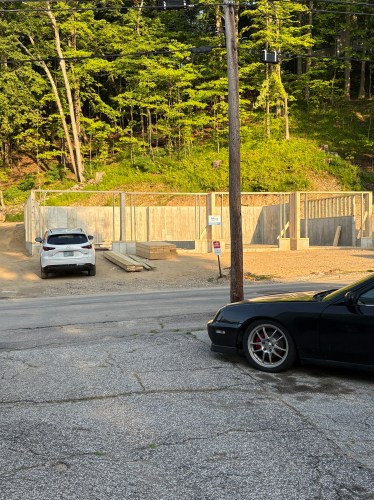
I know I haven’t written about it in many moons, but that duplex that was supposed to be built across the street from us, is finally going up or in.
While we were at the lake on vacation those few days, when we got home, they had the foundation in, and had been making excellent progress.
Pouring cement into forms for the duplex foundation. –Sheila MurreyFoundation on June 25th, 2026. –Sheila MurreyBy July 16th, 2026 the duplex was starting to get framed up. –Sheila MurreyYou can kind of see how large the lot is in this photo. –Sheila Murrey
My husband is usually the ‘Gladys Kravitz’ (if you remember the reference from Bewitched), because from his music studio upstairs in our place, he has the bird’s eye view of the construction. And though it’s none of our business (of course), he lets me know (“Abner, Abner!”) when the work makes progress or stops.
And a couple weeks ago, we had all kinds of drama when the big truck came to deliver one of the modular pieces and as they began to line it up on the foundation, to their surprise, it didn’t fit! Ha! Turns out they’d put the foundation in backwards! So, after much wailing and gnashing of teeth, it was determined they could bring their non-English speaking crew back and do some actual sawing (think cut-n-paste) out of the concrete and pour new where needed to make it right. Whew! I wondered who got fired over that debacle… no idea.
1/4 of the four-part modular duplex going in across the street from us. Too bad the foundation was backwards so they had to send this back to an empty parking lot to wait until the foundation could be corrected. –Sheila MurreyAll four modular pieces are in and on the foundation. –Sheila Murrey
We don’t know if the owners who are putting in the duplex have a building contractor or not, but if they didn’t before, I bet they do now! My daughter has spoken to the owners a few times, and happened to be home the day of all the drama, but she didn’t ask that question. Hopefully, after all is said and done, we’ll get to meet the homeowners and hear more about it. Since my dad was a builder, and we built the home (mom and dad’s dream house) the last five years that I was a teenager, home-building is fascinating to me.
Here’s the current stage of construction:
The roof is now on the duplex. –Sheila Murrey
Yours in consciousness-expansion as we evolve and revolve during our mystical awakening. Doing-my-egoless-best, to take you on a limitless, spiraling integrating ride to better health, doing with more ease and less effort-ing, to help us find and sustain the JOY in our lives! (Sprinkling Gratitude all around while we’re at it.)
Sheila “Spiral Sister” Murrey
The information provided is for educational purposes only and is not intended to treat, diagnose or prescribe.
About us
My husband and I are creators of life-enhancing spiritual and soulful information, music, and digital designs for wholly vibrant living.
Find me over on my YouTube channel for JIGGLE WIGGLE, mobility movement videos, video book reviews, plants, art, and more at: https://youtube.com/@spiralsister
My husband is an award-winning illustrator, plus he’s a seasoned guitarist, bass player, and songwriter (with over 1,400 original songs). You can view some of his artwork and listen to many of his songs at: https://www.youtube.com/user/richardmurrey
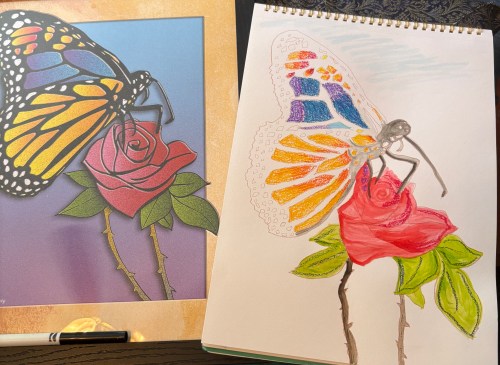
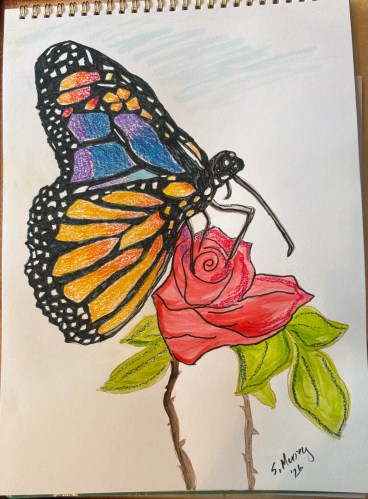
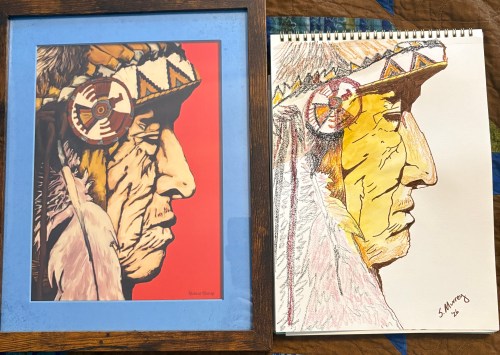
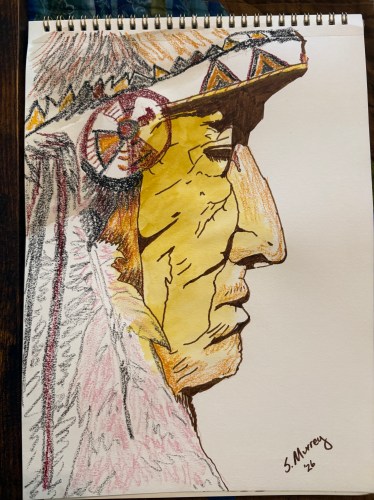
I did two new sketches from out of my husband’s 100+ framed paintings collection and thought you’d enjoy them.
This is my butterfly sketch in progress, because I had no idea that I would finish it yesterday due to all the white dots (so much black to color in), and it did take some time:
Butterfly artwork of Richard’s on the left; my version of the butterfly sketch on paper on the right (in progress). Though I did make a little mistake on the top of the rose, and even laid awake last night thinking of actually cutting some paper and gluing it over the mistake, I’ll leave it alone. –Sheila MurreyFinished butterfly sketch. I am having fun trying to decide where and when to use the watercolor paints. –Sheila MurreyIndian chief artwork of Richard’s on the left; my version of the chief sketch on paper on the right. I started this one with the watercolor as I guessed where his face would be–and yes, I had to make some adjustments when I drew over the pencil with the brown marker, so not all of the watercolor got included on his face, though I think it worked. I might go back and add a bit of pink watercolor to the feather, not sure yet.I also now see where I could add more black to the lower left of the sketch. Hmm –Sheila MurreyNative American Indian Chief sketch. Hubby said I did a good job. And that made my day! –Sheila Murrey
Thankfully, I’m now sleeping a bit better (the shoulder/arm/back pain I have been experiencing is letting up more and more). I am continuing to seek out a good inexpensive comfrey cream. Let me know if you know of a good one.
Breathing in the miracles today…
I’m breathing and repeating my new mantra: “Art communicates more than words, builds new brain neural pathways, and connects us all!”
Yours in consciousness-expansion as we evolve and revolve during our mystical awakening. Doing-my-egoless-best, to take you on a limitless, spiraling integrating ride to better health, doing with more ease and less effort-ing, to help us find and sustain the JOY in our lives! (Sprinkling Gratitude all around while we’re at it.)
Sheila “Spiral Sister” Murrey
The information provided is for educational purposes only and is not intended to treat, diagnose or prescribe.
About us
My husband and I are creators of life-enhancing spiritual and soulful information, music, and digital designs for wholly vibrant living.
We’re songwriters open to placing any of our 1,500+ original songs in TV, film, games, etc. We’re also seeking bands to play our songs. Video content creators, filmmakers, podcasters, production companies, deejays, Vloggers, YouTubers, and more can use our original music and songs in movies, TV shows, video intros, and such.
My husband of 21 years, Richard Murrey, is an award-winning illustrator, plus he’s a seasoned guitarist, bass player, and songwriter (having penned over 1,500 original songs). You can view his artwork and hear original songs at: https://www.youtube.com/user/richardmurrey
Find me over on my YouTube channel for JIGGLE WIGGLE, mobility movement videos, video book reviews, plants, art, and more at: https://youtube.com/@spiralsister
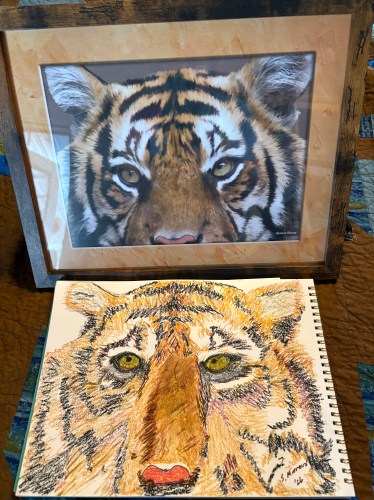
I looked through some of my husband’s 100+ framed paintings to see if I thought I might attempt a sketch of a few more, recall the lions:
This is a face on tiger. I love Richard’s artwork. He always creates a mat for his art as well, so we just print and frame. Easy! He used to sell these for $100 each, but has taken his artwork down due to low sales and too many scam-like emails coming in to him.
Tiger artwork of Richard’s on top; my version of the tiger sketch on paper. I got a little likeness but feel I could have done a better job at mapping out where the white needed to be. I used the watercolors only on the nose and add some “hairy” strokes. –Sheila Murrey
The shoulder/arm/back pain I have been experiencing is starting to ease, though today (and it was our busy grocery day), my arm has had a dull ache all day. Ugh! I found an arnica roll on at Walmart and giving it a try. I am continuing to seek out a good inexpensive comfrey cream. Let me know if you know of a good one. Thanks Julie (over at: https://emotionalpeace.wordpress.com) for the prayers! I chatted with Christina at Herbal-Cottage this morning and she’s ending me a bottle of nerve relief tonic (she was only out of stock on her website)! Yay!
Breathing in the miracles today…
I’m breathing and repeating my new mantra: “Art communicates more than words, builds new brain neural pathways, and connects us all!”
Yours in consciousness-expansion as we evolve and revolve during our mystical awakening. Doing-my-egoless-best, to take you on a limitless, spiraling integrating ride to better health, doing with more ease and less effort-ing, to help us find and sustain the JOY in our lives! (Sprinkling Gratitude all around while we’re at it.)
Sheila “Spiral Sister” Murrey
The information provided is for educational purposes only and is not intended to treat, diagnose or prescribe.
About us
My husband and I are creators of life-enhancing spiritual and soulful information, music, and digital designs for wholly vibrant living.
Find me over on my YouTube channel for JIGGLE WIGGLE, mobility movement videos, video book reviews, plants, art, and more at: https://youtube.com/@spiralsister
My husband is an award-winning illustrator, plus he’s a seasoned guitarist, bass player, and songwriter (with over 1,400 original songs). You can view some of his artwork and listen to many of his songs at: https://www.youtube.com/user/richardmurrey
Thanks to Walmart extending me the offer to become a Recognized Reviewer, I have been searching their 1,000 items list for the last few days and thinking about all the things we need, or want, plus what we might give as holiday gifts, especially to the granddaughters. I’m beyond excited to know that because I’ve freely given Walmart hundreds (I think it’s over 1,000 by now actually), mostly on food items we’ve bought from them in the two years we’ve lived in New Hampshire, that NOW, I will save us at least a few hundred dollars a year by getting free products just for reviewing said items. Yippee!!
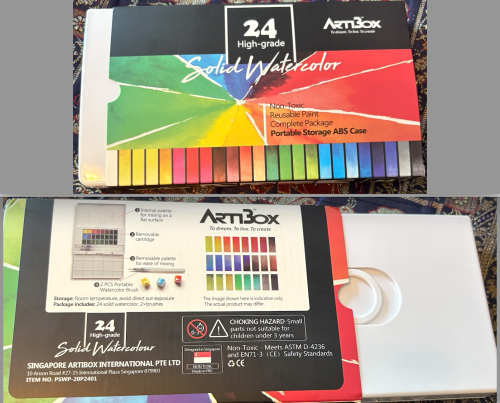
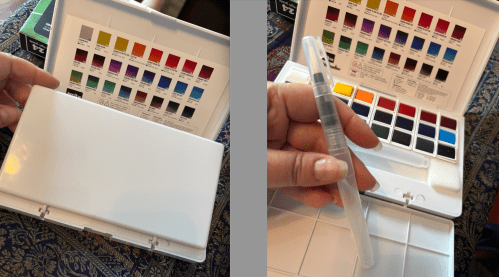
Plus, I can order some items that have not yet been released on Walmart.com! So, I finally found a great watercolor set (and I had been looking and checking different stores online for a while). What a FUN retirement “job” to have now, right? And currently, I am an elite Yelp reviewer too, but I digress. I’m a writer, right? And a writer writes, as we say. So there’s that.
Screen capture of part of the email Walmart sent me about what it means to be a Recognized Reviewer. –Walmart
I had been wanting to try some watercolor painting for months, since my blogger pal, and artist, Linda, has been painting her sketches with watercolor paints. She suggested I get a children’s set of watercolors to begin with and that’s pretty much what I did.
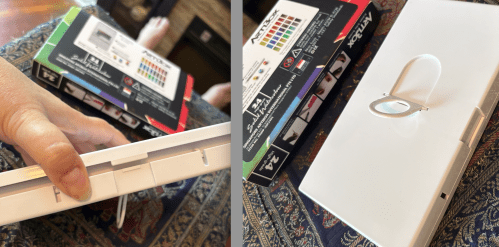
Screen capture: 24 watercolor palette by ArtBox. –Sheila MurreyScreen capture: opening the 24 watercolor palette by ArtBox. I still don’t know what the ring on the bottom of the case is for. –Sheila MurreyScreen capture: the open 24 watercolor palette by ArtBox. Left, what it looked like as soon as I opened it with paint mix tray; on the right, after filling brush pens with water and painting. –Sheila MurreyScreen capture: Left, back of paint mixing palette; right shows closeup of one of the brush pens. I really like that they give you a color chart too, so you know what color is what. –Sheila Murrey
I’ve already left my review of these watercolors on the Walmart site, so this is simply an extra post to show you all, my readers, the background on how I found these and what they are. And it’s all thanks to Linda’s encouragement. Aren’t I lucky?
I’m so thankful for my new mantra: “Art communicates more than words, builds new neural pathways (in the brain), and connects us all!”
Yours in consciousness-expansion as we evolve and revolve during our mystical awakening. Doing-my-egoless-best, to take you on a limitless, spiraling integrating ride to better health, doing with more ease and less effort-ing, to help us find and sustain the JOY in our lives! (Sprinkling Gratitude all around while we’re at it.)
Sheila “Spiral Sister” Murrey
The information provided is for educational purposes only and is not intended to treat, diagnose or prescribe.
About us
My husband and I are creators of life-enhancing spiritual and soulful information, music, and digital designs for wholly vibrant living.
Find me over on my YouTube channel for JIGGLE WIGGLE, mobility movement videos, video book reviews, plants, art, and more at: https://youtube.com/@spiralsister
My husband is an award-winning illustrator, plus he’s a seasoned guitarist, bass player, and songwriter (with over 1,400 original songs). You can view some of his artwork and listen to many of his songs at: https://www.youtube.com/user/richardmurrey
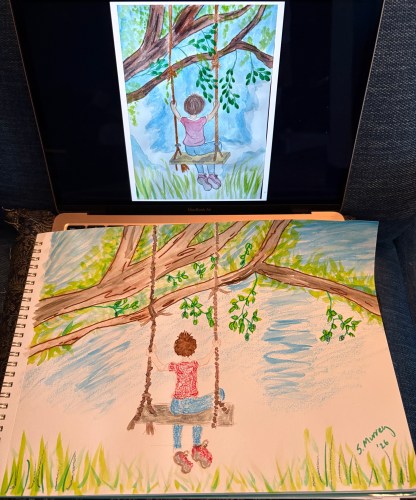
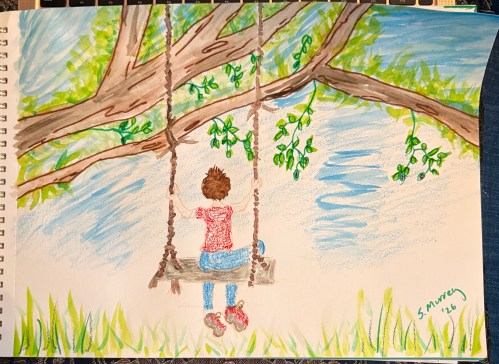
I felt inspired, since receiving my new watercolor kit (Thanks to Walmart! See my next article where I explain the program and show you the kit), that I got to sketching and painting right away yesterday afternoon! I decided to attempt another one of the sketches I’ve held onto for months (from Linda Lewis’ blog). Let me know what you think of it:
Linda Lewis’ child on tree swing sketch on laptop and my version of child on tree swing sketch on paper –Sheila MurreyMy child on tree swing sketch. My critique is that I really need to practice hands (haha! Mine kind of look like claws), and I probably should have used watercolor on the shirt and pants instead of the oil pastels. –Sheila Murrey
The shoulder/arm/back pain I have been experiencing for just over a week is continuing to ease. I checked Walmart for any other kind of pillow or massager, etc. and couldn’t find anything I liked any better than what I have (an ergonomic pillow, TENS machine, and PowerPlate massager in a sort of peanut shape). The herbal tincture from Herbal-Cottage helps, but I believe I need their nerve tonic as well, and they are out of stock on it right now. The Ibuprofen didn’t help at all last night, so I am looking at getting a stronger topical comfrey cream. I found one via a Facebook ad, but it’s about $50 for a 2 ounce jar! Not wanting to spend that, I’m checking elsewhere online. Let me know if you have used a good one.
I’m breathing and repeating my new mantra: “Art communicates more than words, builds new neural pathways (in the brain), and connects us all!”
Yours in consciousness-expansion as we evolve and revolve during our mystical awakening. Doing-my-egoless-best, to take you on a limitless, spiraling integrating ride to better health, doing with more ease and less effort-ing, to help us find and sustain the JOY in our lives! (Sprinkling Gratitude all around while we’re at it.)
Sheila “Spiral Sister” Murrey
The information provided is for educational purposes only and is not intended to treat, diagnose or prescribe.
About us
My husband and I are creators of life-enhancing spiritual and soulful information, music, and digital designs for wholly vibrant living.
Find me over on my YouTube channel for JIGGLE WIGGLE, mobility movement videos, video book reviews, plants, art, and more at: https://youtube.com/@spiralsister
My husband is an award-winning illustrator, plus he’s a seasoned guitarist, bass player, and songwriter (with over 1,400 original songs). You can view some of his artwork and listen to many of his songs at: https://www.youtube.com/user/richardmurrey
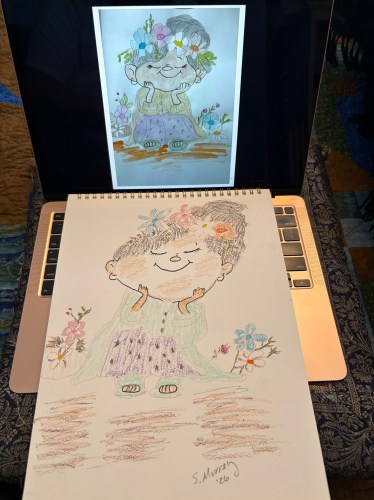
And as Linda has suggested to me, when “you get to the point where the process becomes more like an escape from something on your to-do list, rather than an item on it. THAT’S when you’ll really smile.” And I am smiling, Linda. This was FUN!
Lady sketch, Linda’s original on laptop screen; my replica sketch on paper –Sheila MurreyLady sketch with pencil, marker, and oil pastels –Sheila Murrey
The shoulder/arm/back pain is slowly reducing. I laid on the TENS machine yesterday (and though it was 91 degrees upstairs, I still fell asleep), and it relieves the pain totally only for as long as I’m on it. So, there’s that. I’m still using the PowerPlate handheld massager when the nerve acts up (about once every 30 minutes). The herbal tincture from Herbal-Cottage and arrived yesterday is helping too. I took another (very old) Ibuprofen last night. It occurred to me that whatever relief it’s offering is no doubt slight, as that bottle is at least 10 years old.
I updated my blog site menu on the home page and rewrote the merch/store page at: https://sheilamurrey.net/store/ (its under the Murrey Creations tab on the home page, and it will be at the bottom of each future article too).
And in keeping with our Murrey Creations “Original songs for improving brain health” Facebook public group, I’ve been working on two new original songs for Gina Virginia Casella and her upcoming Fall conference, so I’ll be writing more about that in a week or two.
Richard’s AI graphic for our new Facebook public group. –Richard Murrey
Remember our new mantra: “Art communicates more than words, builds new neural pathways (in the brain), and connects us all!”
Yours in consciousness-expansion as we evolve and revolve during our mystical awakening. Doing-my-egoless-best, to take you on a limitless, spiraling integrating ride to better health, doing with more ease and less effort-ing, to help us find and sustain the JOY in our lives! (Sprinkling Gratitude all around while we’re at it.)
Sheila “Spiral Sister” Murrey
The information provided is for educational purposes only and is not intended to treat, diagnose or prescribe.
About us
My husband and I are creators of life-enhancing spiritual and soulful information, music, and digital designs for wholly vibrant living.
Find me over on my YouTube channel for JIGGLE WIGGLE, mobility movement videos, video book reviews, plants, art, and more at: https://youtube.com/@spiralsister
My husband is an award-winning illustrator, plus he’s a seasoned guitarist, bass player, and songwriter (with over 1,400 original songs). You can view some of his artwork and listen to many of his songs at: https://www.youtube.com/user/richardmurrey
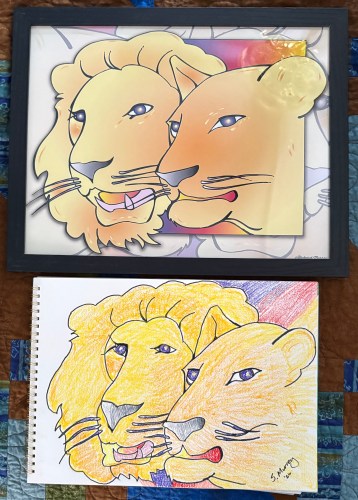
I have completed a sketch of a male and female lion that my husband, retired graphics specialist, Richard Murrey drew and illustrated many years ago and a print of which, hangs in our living room. He used to display his art on a couple of websites, but now, has decided dealing with the random emails and follow through is too much for him. I’m simply thankful he continues to write a few songs and organize them for our radio shows!
I’m making this more of an art day because I am still dealing with shoulder/arm/back pain. I have a TENS machine and laid on it last night when I couldn’t sleep. I also have a QiCoil and PowerPlate handheld massager that helps, but I can only use these for so long as they must be recharged. I now see why people buy two of such things! The TENS is plugged directly into the wall outlet so I could use it all night, though that’s probably not recommended. I’d go back to my naturopath musculoskeletal doc, but I don’t want to have to go to him (at $160 an hour) every time this acts up. And since this is the second time in 8 months it’s been this bad, I think rest, herbal tincture (which thankfully, arrived in the mail yesterday afternoon), and massaging it will help it heal soon. It was so bad last night, it went from an aggravation to a barking pain! And I finally gave in and took ONE Ibuprofen. I do NOT know how people live in pain. I can’t.
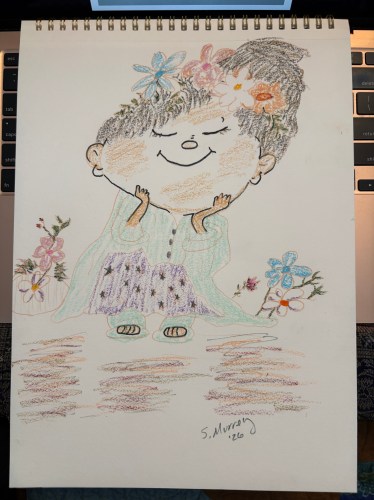
I enjoyed sketching first with a pencil and then going over the lines to perfect them (though I still don’t believe there’s really any Perfection in art), and then adding the colors. As well, I enjoy blending the oil pastels around on the page, as well as kind of making brush strokes (or crayon strokes).
My mantra now is: Art communicates more than words, builds new neural pathways (in the brain), and connects us all!
Yours in consciousness-expansion as we evolve and revolve during our mystical awakening. All while doing-my-egoless-best, to take you on a limitless, spiraling thought ride to better health, through doing more with ease, to help us sustain the JOY in our lives! (With lots of Gratitude throughout.)
Sheila “Spiral Sister” Murrey
The information provided is for educational purposes only and is not intended to treat, diagnose or prescribe.
About us
My husband and I are creators of life-enhancing spiritual and soulful information, music, and digital designs for wholly vibrant living.
Find me over on my YouTube channel for JIGGLE WIGGLE, mobility movement videos, video book reviews, plants, art, and more at: https://youtube.com/@spiralsister
My husband is an award-winning illustrator, plus he’s a seasoned guitarist, bass player, and songwriter (with over 1,400 original songs). You can view some of his artwork and listen to many of his songs at: https://www.youtube.com/user/richardmurrey
You read a self-help book, but don’t integrate the methods. You can’t “find time” to meditate. Therapy keeps you focused on the “problem.” So you still feel like life is happening to you instead of with you.
Here’s what nobody tells you: You don’t need more information. You need integration.
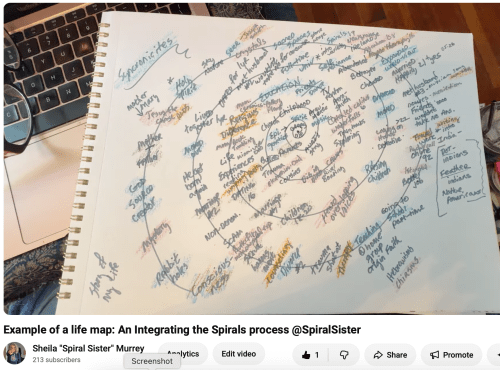
Check out this spiral map I did recently while working the Integrating the Spirals process for myself. It’s what I call a self reflective kind of life review process. Call it what you will, it can help you integrate things into your mind that you may have wondered about. Maybe you’ve asked yourself (or God), “Why did this or that event have to happen TO me?”
I’m Sheila Murrey—IT professional turned holistic health researcher, author, YouTuber, songwriter, and self-described, “Spiral Sister.”
I didn’t always have the answers. But I survived:
Two unhappy marriages before finding my twin flame husband (21+ years strong—yes, third marriages can work)
Years as a single mom raising two kids while working full-time and going to college after the first ex-husband left when our children were 5 and 7
Living with a 2nd ex-husband who fired a gun in my direction (I left. I forgave. I learned.)
Being laid off from a job I loved (2004) and rebuilding my career from scratch
A near-death asthma crisis (2005) that made me question everything conventional medicine told me
Being laid off again (2008) for five months at the Kennedy Space Center (and had to rebuild my career again!)
Selling our dream home in Titusville, FL (2010) after Obama ended the manned space program
Living in an RV with my husband for 11 years and moving all central Florida for contract work; the last 17 months of which we lived off the grid beginning a week prior to the COVID lockdowns of 2020
Caring for my darling husband when he suffered a stroke (Oct. 2022) after a hurricane knocked our power out for ten days, and while I continued to work full-time from home
Every single one of those experiences taught me the same thing: Everything has value. Everything resolves to gratitude. But I had to learn how to get there.
We DE-Program in Integrating the Spirals Method
The spiral process helps us become aware and understand that Life is always working out FOR us. Even when we don’t believe that could possibly be true, such as when bad things happen to good people!
Integrating the Spirals Method: What You’ll Get
I’ve codified 20+ years of epiphanies, synchronicities, and hard-won lessons into sessions that blends spirituality with science, music therapy, and practical daily practices.
Playing together we’ll:
Key #1: Honor Your Innermost Being & Ancestors
Move from living in struggle, fear, and shame to sharing your truth with a gratitude mindset. You’ll learn to:
Record and review yourself to spot emotional patterns
Meditate (or feel your pulse if meditation feels impossible)
Use music and sound therapy to access deep relaxation
Key #2: Perspective Shapes Beliefs
Let go of the need to be right and start feeling supported by the Universe. We’ll explore:
Kaleidoscope & Mirror Ball Multiple Perspectives Exploration (shadow work for sensitive types)
Why no one can see the whole picture at once–this is why we play with a spiral map!
How to stop judging your beginning against someone else’s years of practice (and judge less period, since we can never really know a person)
Key #3: WordPlay—Identify and Release Your Triggers
Identify your trigger words, and release the charge they have within you.
Bonus: Original Music Brain Stimulation
My darling husband Richard has written over 1400 original songs (we’ll play a portion of one each session) to help you grow new neural pathways, stimulate your creativity, and grow your “what’s possible” mindset.
Who This Is For
This program is for you if:
You’re currently triggered or emotionally charged by family conflicts, relationship drama, or news/social media
You feel torn apart, confused, or estranged from loved ones
You’re ready to stop people-pleasing and start feeling better in any situation
You want to retain emotional balance during intimidating, PTSD-triggering conversations.
Who This Is NOT For
This isn’t for you if you’ve decided:
Life has to be hard and a struggle
You enjoy suffering or the benefits of it or must “always be right”
You love to argue and “know everything”
You don’t feel you’re worthy of love or feel you can’t change your life
The Investment (And Why It’s Worth It)
4 transformational sessions: $181
Why $181? Because the Tao Te Ching has 81 verses, and in numerology, 181 reduces to 1—new beginnings.
Example of a life map; self reflecting tool to help one see that Life is always happening FOR us, even when we find that concept hard to believe. –Sheila Murrey
What you get:
Daily reminders via Messenger or text
2 weekly group Zoom calls (groups of four or less)
Deep-dive WordPlay work (where Sheila listens to you and spots the words you use that are holding you back)
Kaleidoscope and mirrorball philosophy
Mini areas of focus and role-playing exercises
Access to a private, intimate mastermind-style group
Don’t think you can afford it? Message me. I’m offering a Pay What You Want option today because I don’t want to exclude anyone due to lack of funds.
What Makes This Different
Science meets Spirituality: I blend mind-body strategies such as, Emotional Freedom Technique (EFT) with mobility exercises and dance.
Art and Music Therapy: Drawing out the spiral on paper and mapping out your challenges and identified solutions, plus listening to original songs help build new neural pathways in the brain!
Esoteric & Practical: People from all religious backgrounds welcome. We explore Holism, Omnism, and the mystical principle that you’re “never alone.”
Real Talk: We’ve been scammed, even by people we had built relationships with. We still have to stay resolute, using wise discernment, or we can be tricked. We’re human and want to believe most people are inherently GOOD!
A Story That Changed Everything
My maternal grandmother taught me about the Cherokee “Trail of Tears”—the 1839 forced march where thousands died.
Only one of the five relocated tribes remembered what starvation felt like. Yet just 10 years later, the Choctaws sent food across the ocean to Ireland during the Great Hunger.
When people truly change, it shows up in their actions.
My grandmother never judged someone knocking on her door during the Great Depression of 1929 because she believed we might be “entertaining angels unaware.” That’s the energy I bring to this work.
Your Next Step
If any of this resonates—if you’re ready to ask a different question, feel from another perspective, and integrate what you learn so your cells remember—let’s talk.
I’m here to assist—not save. I’m one person, and I seek to play with earnest, hungry, seriously motivated individuals who are ready for soul growth and personal transformation.
We Are All Connected. Whether we like it or not. And our world needs us to be kind and compassionate—not out of fear, but out of true, unconditional love.
Final Thought
You can’t say the wrong thing to the right people. Think of your children, grandchildren, or beloved. You love them unconditionally. Now, let’s do that for ourselves.
Put your hand on your heart. Speak from your centered, balanced heart space in LOVE. The Universe always, in all ways, has your back.
❤️🦋🌀🎼☯️
Yours in consciousness-expansion as we evolve and revolve during our mystical awakening. All while doing-my-egoless-best, to take you on a limitless, spiraling thought ride to better health, through doing more with ease, to help us sustain the JOY in our lives! (With lots of Gratitude throughout.)
Sheila “Spiral Sister” Murrey
The information provided is for educational purposes only and is not intended to treat, diagnose or prescribe.
About us
My husband and I are creators of life-enhancing spiritual and soulful information, music, and digital designs for wholly vibrant living.
Find me over on my YouTube channel for JIGGLE WIGGLE, mobility movement videos, video book reviews, plants, art, and more at: https://youtube.com/@spiralsister
My husband is an award-winning illustrator, plus he’s a seasoned guitarist, bass player, and songwriter (with over 1,400 original songs). You can view some of his artwork and listen to many of his songs at: https://www.youtube.com/user/richardmurrey
A dear friend of mine (and fellow blogger) who now lives in Thailand has been writing a series of blog articles that I want to draw attention to… you might also know she’s been my sketch teacher and weight loss/exercise motivator for the last couple of years as well. Linda Lewis.
As you know, I LOVE that Brian found a way to bridge Meditation and Thankfulness in this “5 minutes of Gratitude” type of practice. It’s really biblical too, when one thinks about it, as we’re admonished over and over again “not to worry” and to “trust in God.” So, this practice of Gratitude not only fits the Buddhist philosophy and spiritual take on things, but also the biblical perspective. I love it and want to promote it as well.
I had a statement (not a mental image) drop in during a meditation I was doing years ago and it was that “Everything Resolves to Gratitude.” Of course, THAT is harder to understand and “reach” as a place of knowing than it is said.
I get big topics like that when I meditate, which is why I don’t meditate daily anymore. Until the world is ready for me, well, hehe, a small fraction may only ever be, I will hold back. But I’m probably wrong and just tired after getting this last book out that still so few want. As for the “woo-woo” stuff, you know I love it and LIVE for the woo! I am soooo glad you got that mental image “drop in” of Harvey and Brian. The peace and comfort it gave you then, the tears were cleansing, is one that I do not believe will ever leave you. And that my dear friend WAS a metaphysical experience. Yay WOO!
Watch the last 20 minutes this
I was pleasantly surprised when after the 2 hour mark, https://youtu.be/ur_-7JONZlY?si=r-2mEVwO0o0lWK1G Tim Robbins shared a metaphysical experience of his with Joe Rogan and Joe didn’t try to debunk it! I won’t spoil it, but it’s REALLY good!!! I think it starts about 2.06:00 or 2.07:00; I did make a comment on the video and tried to mark it.
Proving the WOO
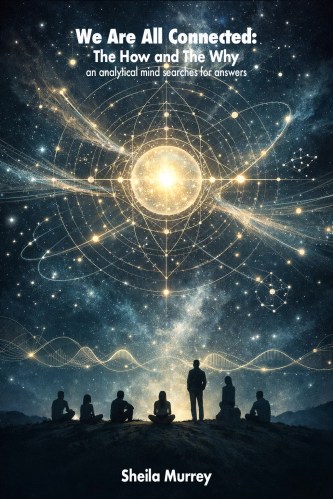
One of the readers of my latest book, We Are All Connected: The How and The Why, has told me and a Unity group he hosts that my book offers a thousand ways or more to prove the WOO exists and connects us all. It was a pretty big tell and my jaw actually dropped open when he proclaimed it. Thanks Andy. I believe very soon the connection between heaven and earth will make the WOO visible and quite undeniable to ALL. Til then, anyone who is interested can read my book.
My book, We Are All Connected: The How and The Why
Find me over on my YouTube channel for JIGGLE WIGGLE, mobility movement videos, video book reviews, plants, art, and more at: https://youtube.com/@spiralsister
Yours in consciousness-expansion as we evolve and revolve during our mystical awakening. All while doing-my-egoless-best, to take you on a limitless, spiraling thought ride to better health, through doing more with ease, to help us sustain the JOY in our lives! (With lots of Gratitude throughout.)
Sheila “Spiral Sister” Murrey
The information provided is for educational purposes only and is not intended to treat, diagnose or prescribe.
About us
My husband is an award-winning illustrator, plus he’s a seasoned guitarist, bass player, and songwriter (with over 1,400 original songs). You can view some of his artwork and listen to many of his songs at: https://www.youtube.com/user/richardmurrey
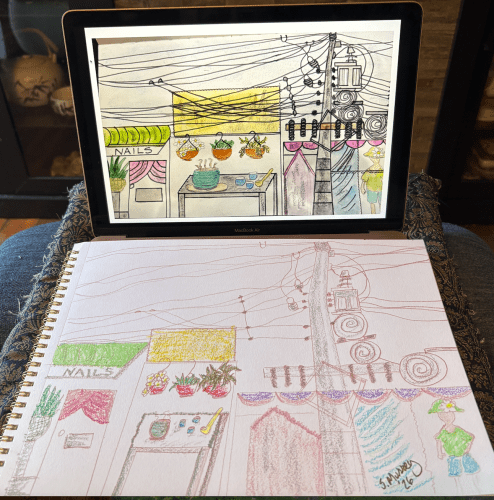
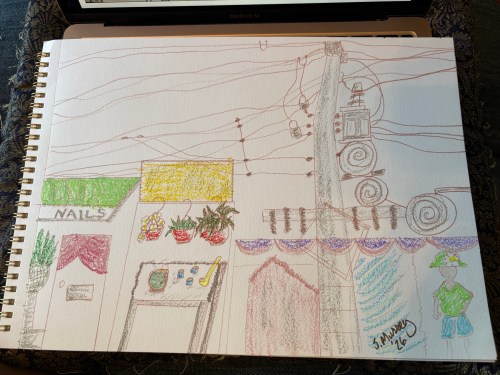
I just finished a sketch of a Thai scene (thanks and link to Linda Lewis), from a lovely sketch that Linda shared on Apr. 7th! That’s how far behind I am on my sketching. That is on the list of several I’ve saved from Linda to help me learn and stay motivated. It was one of her first Thai scenes with all the wires! I don’t know if I did it justice or not, but will share it anyway.
Thai sketch, from Linda Lewis’ sketch of Apr. 7th, 2026 –Sheila Murrey
I have another Integrating the spirals blog in draft, but waiting to make the video for it, so it can wait.
Art takes precedence for me today since I am in shoulder/arm/back pain AGAIN. Ugh! I do NOT know what I did, but I have had to take a break from the hanging mobility exercises. And to think, that was what got me out of the pain for the last 2 months! I just don’t know. On top of that, I am aggravated because I finally had my Zoom call with my new doctor’s office (the one in Maine I went to nearly two months ago for all the testing and blood labs) and they did NOT give me much new information to go on. Plus they wanted $2500 for a membership just to save me on all the prescriptions and supplements they were going to recommend. NOPE! I ordered the bare minimum supplements from them and will discuss the rest with my local naturopathic doctors (husband and wife docs). I’m all slathered up with Stopain and the like (topical pain relievers since I don’t take Ibuprofen or such), just to be able to type! I also ordered more of the herb pain tonic too (from Christina at Herbal-Cottage in Florida). It’s a godsend for nerve pain relief.
Closeup of my Thai sketch, from Linda Lewis’ sketch of Apr. 7th, 2026 –Sheila Murrey
I did enjoy sketching this scene and think it helped take my mind off this pain. I did the whole sketch with a brown pencil that did not erase well. So, anything I felt I needed to change, I took care of when I began coloring with the oil pastels. I’m learning now to only shade one side of pots with color to allow for the light that might be shining on them from the top/other side. Let me know if that worked well. I loved the spirals in this, but of course!
I continue to remind myself that Art can communicate more than words and not only connects us all, but makes new neural pathway connections in the brain too! Ah, the brain is such a funny (odd, not haha funny) and mysterious organ of the body.
My book, We Are All Connected: The How and The Why
Find me over on my YouTube channel for JIGGLE WIGGLE, mobility movement videos, video book reviews, plants, art, and more at: https://youtube.com/@spiralsister
Yours in consciousness-expansion as we evolve and revolve during our mystical awakening. All while doing-my-egoless-best, to take you on a limitless, spiraling thought ride to better health, through doing more with ease, to help us sustain the JOY in our lives! (With lots of Gratitude throughout.)
Sheila “Spiral Sister” Murrey
The information provided is for educational purposes only and is not intended to treat, diagnose or prescribe.
About us
My husband is an award-winning illustrator, plus he’s a seasoned guitarist, bass player, and songwriter (with over 1,400 original songs). You can view some of his artwork and listen to many of his songs at: https://www.youtube.com/user/richardmurrey
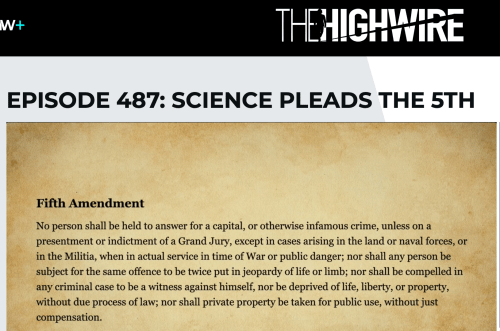
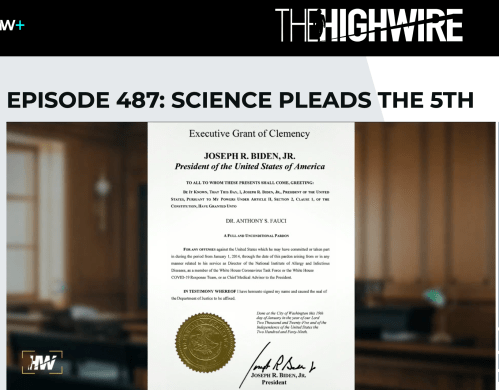
Del Bigtree said it best at the end of episode 487 on The Highwire, that Anthony Fauci chose (on the advice of his counsel) to sit there and plead the 5th and not be able to “talk, talk, talk” and “get his last word in” in his defense, while everyone else got to speak for/about him. And that was perhaps a “fate worse than death” for him. What do you think? I captured a few screenshots from the show, and here’s a link to the episode: https://thehighwire.com/watch/
Fifth Amendment –Credit to The HighwireBiden’s autopen 10-year pardon of Fauci –Credit to The HighwireYou and I may not be a doctor or scientist but senator Rand Paul is a doctor and I thought he did an excellent job during the Senate hearing. –Credit to The HighwireFauci knew from the very beginning of the pandemic that COVID didn’t come from a wet market. –Credit to The HighwireFauci’s diary note; Jan. 26, 2020 about the first infection in December 2019 that it was NOT connected to the wet market. –Credit to The HighwireHouse panel concludes that COVID-19 pandemic came from a lab leak. –Credit to The Highwire
Before the end of the Highwire episode, Del also spoke with Serene Allison and her son Arden at what happened to him after getting dowsed with Roundup at work. What a miracle he survived! That story calmed me.
I’ve spent the last few days spewing on Facebook my opinion about Fauci’s Senate hearing nonsense, but after watching Del Bigtree today on the Highwire, I’m over it. And I’m here to state that for the record. Practicing what I teach.
We Are All Connected. Whether we like it or not. And our world needs us to be kind and compassionate—not out of fear, but out of true, unconditional love.
❤️🦋🌀🎼☯️
Creators of life-enhancing spiritual and soulful information, music, and digital designs for wholly vibrant living
My book, We Are All Connected: The How and The Why
Find me over on my YouTube channel for JIGGLE WIGGLE, mobility movement videos, video book reviews, plants, art, and more at: https://youtube.com/@spiralsister
Yours in consciousness-expansion as we evolve and revolve during our mystical awakening. All while doing-my-egoless-best, to take you on a limitless, spiraling thought ride to better health, through doing more with ease, to help us sustain the JOY in our lives! (With lots of Gratitude throughout.)
Sheila “Spiral Sister” Murrey
The information provided is for educational purposes only and is not intended to treat, diagnose or prescribe.
About us
My husband is an award-winning illustrator, plus he’s a seasoned guitarist, bass player, and songwriter (with over 1,400 original songs). You can view some of his artwork and listen to many of his songs at: https://www.youtube.com/user/richardmurrey
You’re exhausted. Not just tired—drained. The kind of exhaustion that comes from constantly managing other people’s emotions, walking on eggshells around family, or feeling triggered by every news headline and Facebook argument.
You’ve tried the self-help books. The meditation apps. The therapy. But you’re still stuck in the same cycles: people-pleasing, emotional reactivity, feeling like life is happening to you instead of with you.
Here’s what nobody tells you: You don’t need more information. You need integration.
Meet Your Spiral Sister
I’m Sheila Murrey—IT professional turned holistic health researcher, author, YouTuber, songwriter, and self-described, “Spiral Sister.”
I didn’t always have the answers. But I survived:
Two unhappy marriages before finding my twin flame husband (21+ years strong—yes, third marriages can work)
Years as a single mom raising two kids while working full-time and going to college after the first ex-husband left when our children were 5 and 7
Living with a 2nd ex-husband who fired a gun in my direction (I left. I forgave. I learned.)
Being laid off from a job I loved (2004) and rebuilding my career from scratch
A near-death asthma crisis (2005) that made me question everything conventional medicine told me
Being laid off again (2008) for five months at the Kennedy Space Center (and had to rebuild my career again!)
Selling our dream home in Titusville, FL (2010) after Obama ended the manned space program
Living in an RV with my husband for 11 years and moving all central Florida for contract work; the last 17 months of which we lived off the grid beginning a week prior to the COVID lockdowns of 2020
Caring for my darling husband when he suffered a stroke (Oct. 2022) after a hurricane knocked our power out for ten days, and while I continued to work full-time from home
Every single one of those experiences taught me the same thing: Everything has value. Everything resolves to gratitude. But I had to learn how to get there.
Why Traditional Approaches Fail
Most coaching, therapy, and self-help treats you like you’re broken and need fixing. They sell you one layer of the onion as the whole truth.
But you’re not one-dimensional. You are spirit, mind, body, and soul—and they all need to be addressed together. That’s what I call Total Metamorphosis: holistic practices for healing your body, transforming your mindset, and creating real success in your life!
The Integrating the Spirals Method: What You’ll Get
I’ve codified 20+ years of epiphanies, synchronicities, and hard-won lessons into sessions that blends spirituality with science, music therapy, and practical daily practices.
Here’s what we’ll do together:
Key #1: Honor Your Innermost Being & Ancestors
Move from living in struggle, fear, and shame to sharing your truth with a gratitude mindset. You’ll learn to:
Record and review yourself to spot emotional patterns
Meditate (or feel your pulse if meditation feels impossible)
Use music and sound therapy to access deep relaxation
Key #2: Perspective Shapes Beliefs
Let go of the need to be right and start feeling supported by the Universe. We’ll explore:
Kaleidoscope & Mirror Ball Multiple Perspectives Exploration (shadow work for sensitive types)
Why no one can see the whole picture at once
How to stop judging your beginning against someone else’s years of practice (and judge less period, since we can never really know a person)
Key #3: WordPlay—Clean Up Your Triggers
Identify the words that charge you emotionally (mask, facts, control, truth, liberty, God, etc.) and learn to reframe them so you don’t “fly off the handle.”
Bonus: Original Music Brain Stimulation
My darling husband Richard has written over 1400 original songs (we’ll play a portion of one each session) to help you grow new neural pathways, stimulate your creativity, and grow your “what’s possible” mindset.
Who This Is For
This program is for you if:
You’re currently triggered or emotionally charged by family conflicts, relationship drama, or news/social media
You feel torn apart, confused, or estranged from loved ones
You’re ready to stop people-pleasing and start feeling better in any situation
You want to retain emotional balance during intimidating, PTSD-triggering conversations.
Who This Is NOT For
This isn’t for you if you’ve decided:
Life has to be hard and a struggle
You enjoy suffering or the benefits of it or must “always be right”
You love to argue and “know everything”
You don’t feel you’re worthy of love or feel you can’t change your life
The Investment (And Why It’s Worth It)
4 transformational sessions: $181
Why $181? Because the Tao Te Ching has 81 verses, and in numerology, 181 reduces to 1—new beginnings.
What you get:
Daily reminders via Messenger or text
2 weekly group Zoom calls (groups of four or less)
Deep-dive WordPlay work (where Sheila listens to you and spots the words you use that are holding you back)
Kaleidoscope and mirrorball philosophy
Mini areas of focus and role-playing exercises
Access to a private, intimate mastermind-style group
Don’t think you can afford it? Message me. I’m offering a Pay What You Want option today because I don’t want to exclude anyone due to lack of funds.
What Makes This Different
Science meets Spirituality: I blend mind-body strategies such as, Emotional Freedom Technique (EFT) with mobility exercises and dance
Music Therapy: Richard’s original compositions help build new neural pathways
Esoteric & Practical: People from all religious backgrounds welcome. We explore Holism, Omnism, and the mystical principle that you’re “never alone.”
Real Talk: I’ve unfriended people on Facebook. I’ve been triggered. I’m human. But I’ve learned to get my grip back—and so can you.
A Story That Changed Everything
My maternal grandmother taught me about the Cherokee “Trail of Tears”—the 1839 forced march where thousands died.
Only one of the five relocated tribes remembered what starvation felt like. Yet just 10 years later, the Choctaws sent food across the ocean to Ireland during the Great Hunger.
When people truly change, it shows up in their actions.
My grandmother never judged someone knocking on her door during the Great Depression of 1929 because she believed we might be “entertaining angels unaware.” That’s the energy I bring to this work.
Your Next Step
If any of this resonates—if you’re ready to ask a different question, feel from another perspective, and integrate what you learn so your cells remember—let’s talk.
I’m here to assist—not save. I’m one person, and I seek to play with earnest, hungry, seriously motivated individuals who are ready to dig into this “play” for soul growth and personal transformation.
We Are All Connected. Whether we like it or not. And our world needs us to be kind and compassionate—not out of fear, but out of true, unconditional love.
Final Thought
You can’t say the wrong thing to the right people. Think of your children, grandchildren, or beloved. You love them unconditionally. Now it’s time to do that for yourself.
Put your hand on your heart. Speak from your centered, balanced heart space in LOVE. The Universe always, in all ways, has your back.
❤️🦋🌀🎼☯️
Creators of life-enhancing spiritual and soulful information, music, and digital designs for wholly vibrant living
My book, We Are All Connected: The How and The Why
Find me over on my YouTube channel for JIGGLE WIGGLE, mobility movement videos, video book reviews, plants, art, and more at: https://youtube.com/@spiralsister
Yours in consciousness-expansion as we evolve and revolve during our mystical awakening. All while doing-my-egoless-best, to take you on a limitless, spiraling thought ride to better health, through doing more with ease, to help us sustain the JOY in our lives! (With lots of Gratitude throughout.)
Sheila “Spiral Sister” Murrey
The information provided is for educational purposes only and is not intended to treat, diagnose or prescribe.
About us
My husband is an award-winning illustrator, plus he’s a seasoned guitarist, bass player, and songwriter (with over 1,400 original songs). You can view some of his artwork and listen to many of his songs at: https://www.youtube.com/user/richardmurrey