Uncover Your Soul with help from an Analytical Empath

Do you know that’s what we’re doing here? Uncovering our souls? I mean, we do it in art and music. And in our blog writing and book writing. When I wrote in my book, Blue Eyes: Ethereal Messages of Connection and on this blog about feeling the GodBumps, that’s what it is! It’s the uncovering of my soul. It’s an alignment thing, I’m sure.

Here’s the three books I’m currently reading, actually, I am reading four, but the fourth is not a spiritual book and I’ll be doing a review on it in a separate post when I’ve finished it. But these three do align and challenge me in all the right and cool ways! I’m learning so much, uncovering my soul, and it feels like I’m amping my spirituality up a big notch–no ego in this when I say that either. I’m humbled throughout this process. Speaking of humbling…
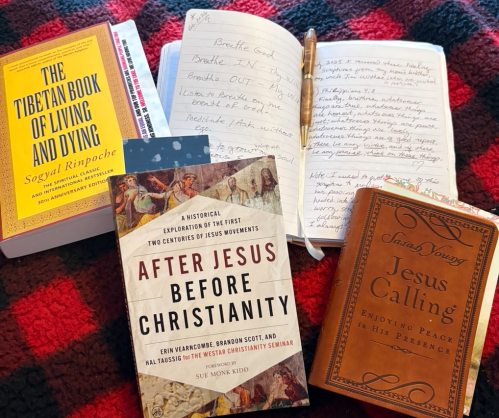
Three spiritual books I’m reading currently, The Tibetan Book of Living and Dying, After Jesus Before Christianity, and Jesus Calling (a daily devotional) –Sheila Murrey

I pictured the books along with my daily journal that I write scriptures in to sing them back to myself, God, and Richard (when he’s in the room). I’m about a third of the way through all three books, and the Tibetan book is the one I’m studying with my Theosophy book club, so we get to discuss a lot of it–and that’s really cool.

Taking a bit of my own medicine

This morning I got a message from one of my Facebook friends, fellow blogger and book reader, who let me know that her new printed version of my new book was still not right. Ugh! Frustrated, I went back into Scrivener, checked it and made a couple of changes and attempted to upload it. But Kindle Direct Publishing would NOT accept it. And the twenty errors did NOT make sense to me. One was a font issue and the font it named was not a font I’ve EVER used, and there was no way for me to find it within Scrivener (that I know of). I was about ready to delete all twenty items, but one was the entire Table of Contents. I did end up deleting the ToC and adding it again, just to be sure. After about five uploads and the Previewer would NOT let me APPROVE it (the Approve button would not light up/activate for me to click), I reached out in a chat with KDP.

During the chat, my darling husband came downstairs and interrupted me wanting to go outside for a walk. Now, it’s 40 degrees out, but sunny and I had promised him that as long as it wasn’t snowing or raining, we’d walk. No matter how cold it is, though it is supposed to be 55 degrees this afternoon. I tried to get him to wait until this afternoon but he fussed (I do tease him that after his stroke, he’s my toddler), but alas, in my head I thought, “Just go for the walk, Sheila.” So, that’s what I did. Though I was over my eyeballs frustrated with Amazon. Okay?

We had a lovely walk, and when I came back in the house and opened the laptop up, I looked at the Amazon KDP screen again and noticed something that made me realize KDP had NOT actually uploaded my final document upload. So, I did the upload again and crossed my fingers. I went to the restroom and when I came back, TADA! The upload worked AND that Approve button lit up! So, I approved the upload and it accepted it! I hope to God this is the last time I ever have to touch Amazon KDP!

So, I had typed quite a bit of this former few paragraphs into a comment to a friend on her blog and no kidding, it wouldn’t take it! It showed me a message that my comment would not be posted. I think it was because I had to login again but in that moment, I couldn’t even process how much the Universe was showing me that when I’m aggravated it’s just simply not going to respond to me! Ha!

I took a break and came back and have now rekeyed it all into THIS post. We’ll see if WordPress will save it, or allow me to publish it. LOL

I’ve got a few new book ads out too, so if you’re following my YouTube channel or any of my other socials you’ll see them. Check out the book too, if you’re at all interested. Or pick up a copy for a woo-woo type friend. I would really appreciate it.


My new book, We Are All Connected: The How and The Why

Here’s the link where you can grab a copy of, We Are All Connected: The How and The Why. An analytical mind searches for answers.
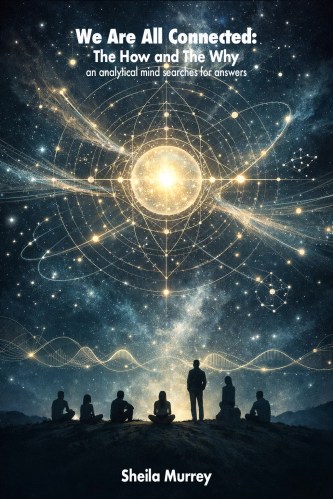
See me talking about my new 5th book on YouTube –>> https://youtube.com/shorts/RKmIIucsMs4?feature=share and here’s how to get a paperback copy of, We Are All Connected: The How and The Why. https://amzn.to/4s7n3Jg or eBook version: https://amzn.to/3PAvfUK

Integrating the Spirals – JIGGLE WIGGLE

In my YouTube channel, I encourage those “over 50” to:

  • Open to lifelong learning (observe, gently question, and loosen up pre-conceived beliefs, aka ‘Programming’)
  • Become more aware of our thoughts and emotions to encourage more ease
  • Loosen up and move our bodies (we’re stuck in our heads also due to our “Programming” and physically unhealthy)
  • And become strong and resilient in spirit, soul, mind, and body.
  • And to question EVERYTHING!

Link to my YouTube channel where you can see the videos: https://youtube.com/@spiralsister


Yours in consciousness-expansion as we evolve and revolve during our mystical awakening. All while doing-my-egoless-best, to take you on a limitless, spiraling thought ride to better health, through doing more with ease, to help us sustain the JOY in our lives! (With lots of Gratitude throughout.)

Sheila “Spiral Sister” Murrey

The information provided is for educational purposes only and is not intended to treat, diagnose or prescribe.


About us

My husband is an award-winning illustrator, plus he’s a seasoned guitarist, bass player, and songwriter (with over 1,000 original songs). You can view some of his artwork and listen to many of his songs at: https://www.youtube.com/user/richardmurrey

Here’s a video of us performing on Vimeo: https://vimeo.com/416711742?ref=fb-share

Connect with us socially at:
I am Spiritual, but without dogma. Period.

As I wrote in my post yesterday, https://sheilamurrey.net/2026/04/03/integrating-the-spirals-exploring-the-last-deception/ I feel we’ve been deceived many times, not only by our politicians, but by the powers that be, belief systems, books, creeds, dogmas and unseen forces.

My husband asked me why I even watched The Lazarus Initiative’s Symposium 55, and I think it’s because I am always open to new information and then, if something from the conversation sparks my curiosity, I dig deeper. And that’s exactly what happened when I listened to Dave Emery and Sacha Stone’s conversation.

So, like I wrote yesterday, I decided to dive into the question, “What are the 14 books that were omitted from the Bible?” and here’s what I found (with the help of Perplexity.ai):

The 14 books commonly referred to as the Apocrypha were removed from the Protestant Bible, primarily in the 19th century, though they were separated by Martin Luther in the 16th century. These books—which appeared in the 1611 King James Bible—were excluded because they were not in the Hebrew Bible and were deemed less authoritative than canonical texts. 

The 14 books are: 

  1. 1 Esdras
  2. 2 Esdras
  3. Tobit
  4. Judith
  5. Rest of Esther (Additions to Esther)
  6. Wisdom of Solomon
  7. Ecclesiasticus (Sirach)
  8. Baruch and the Epistle of Jeremiah
  9. Song of the Three Holy Children (Additions to Daniel)
  10. Story of Susanna (Additions to Daniel)
  11. Bel and the Dragon (Additions to Daniel)
  12. Prayer of Manasseh
  13. 1 Maccabees
  14. 2 Maccabees 

Why They Were Removed 

Protestant Reformation: Reformers like Martin Luther preferred to follow the Hebrew canon of the Old Testament for the Protestant Bible, considering the Apocrypha as useful for reading but not for establishing doctrine.

Theological Differences: Several books contained doctrines that Protestant reformers disagreed with, such as purgatory, prayers for the dead, and salvation by works (e.g., in Maccabees and Tobit).

Language and Authority: These books were primarily found in the Greek Septuagint rather than the Hebrew scriptures, leading to questions about their divine inspiraCurrent StatusThese books are still considered part of the biblical canon by the Roman Catholic, Eastern Orthodox, and Oriental Orthodox churches, deuterocanonical books. They are generally omitted from Protestant Bibles today, though they were included in the original 1611 King James Bible as a separate section.

What’s in those 14 books?

The “14 missing books” are the Apocrypha (or Deuterocanonicals): Greek‑Jewish writings that were included in the 1611 King James Bible and in the early Christian Old Testament (Septuagint), but which most Protestant churches later removed to the side or omitted altogether. Eastern‑rite Christians (Catholic, Orthodox, etc.) still count many of these as fully canonical Scripture.

Here’s the 14 books/additions with a brief summary of each:


1. 1 Esdras

A Greek reworking of parts of 2 Chronicles, Ezra, and Nehemiah, with extra material and a different order. It focuses on the return from exile and the issue of intermarriage with foreign women, framed as a test of faithfulness.

2. 2 Esdras (4 Ezra)

A Jewish apocalypse written after the destruction of the Second Temple (c. late 1st century CE). A visionary “Ezra” asks God why the righteous suffer and why Israel has been so grievously punished; the book stresses God’s patience and final judgment, and it includes visions of the end‑time and the Messiah.

3. Tobit

A pious Israelite, Tobit, living in exile in Nineveh, turns blind. His son, Tobias, journeys with a disguised angel (Raphael) to recover money and marries Sarah, who has been plagued by a demon. Tobias drives the demon away and later cures his father’s blindness, blending family piety, angelic guidance, and healing.

4. Judith

A courageous Jewish widow, Judith, enters the camp of Holofernes, an Assyrian general besieging her people. She seduces and plies him with wine, then beheads him while he is drunk, causing the enemy army to collapse and saving Jerusalem. The book is a powerful story of faith, resistance, and female heroism.

5. Additions to Esther (Rest of Esther)

These are six Greek insertions into the Book of Esther that add prayers, visions, and explicit references to God. They turn the Hebrew Esther’s largely “hidden‑name‑of‑God” story into a more overtly religious narrative of fasting, divine deliverance, and Jewish unity.

6. Wisdom of Solomon (Wisdom)

A philosophical “wisdom” book,” written in the persona of Solomon. It contrasts the wise, righteous person who seeks God’s wisdom with the foolish, wicked person who pursues pleasure and power. It also touches on immortality, judgment, and divine justice, and became influential in later Christian theology.

7. Ecclesiasticus (Sirach / Ben Sira)

A large collection of traditional Jewish wisdom, modeled on Proverbs. It covers practical advice on honoring parents, friendship, speech, humility, work, and piety, and includes a famous hymn praising famous Israelites. It feels like a very “rabbinic‑style” instruction manual.

8. Baruch (with the Epistle of Jeremiah)

Baruch is presented as the secretary of the prophet Jeremiah, writing from Babylon to exiled Jews. It contains lament, confession of sin, and hope for restoration, and then includes a short letter (often called the Epistle of Jeremiah) that sharply mocks idol worship and false gods.

9. Song of the Three Holy Children (Prayer of Azariah and Song of the Three Jews)

This is an addition to Daniel 3, inserted into the fiery‑furnace scene. It includes a prayer of Azariah (Abed‑nego) while in the fire and a long hymn of praise by the three young men, expanding the motif of unbroken worship in suffering.

10. Story of Susanna (Susanna and the Elders)

Also an addition to Daniel (often Dan 13), it tells of a virtuous Jewish woman, Susanna, falsely accused of adultery by two corrupt elders. The young prophet Daniel shames the elders by exposing their contradictory testimony, sparing Susanna’s life and condemning the elders. It’s a suspenseful courtroom drama about justice and integrity.

11. Bel and the Dragon

Another Daniel‑addition (often Dan 14), where Daniel exposes the fraud behind a Babylonian idol, Bel, by showing the priests steal the nightly offerings. He then kills a “dragon”‑idol by giving it a poisonous concoction, demonstrating that pagan gods are ritual theater, not real deities.

12. Prayer of Manasseh

A short penitential prayer attributed to King Manasseh of Judah, who according to 2 Kings was one of the most wicked kings. The prayer portrays a king who, after suffering for his sins, deeply repents and begs God for mercy, emphasizing grace and forgiveness.

13. 1 Maccabees

A historical narrative of the Maccabean Revolt (2nd century BCE) against the Seleucid king Antiochus IV Epiphanes, who tried to force Hellenization and outlaw Jewish practices. It celebrates the family of Judas Maccabeus, their military victories, and the rededication of the Jerusalem Temple (the origin of Hanukkah).

14. 2 Maccabees

A more theologically oriented and selective retelling of part of the same revolt, focusing on martyrdom, the resurrection of the dead, and the efficacy of prayers for the dead. It emphasizes that God rewards faithfulness beyond death and that Jewish resistance is ultimately under divine protection.


Why many were “removed” from Protestant Bibles

  • They were written mostly in Greek, not Hebrew, and were not in the Jewish (Masoretic) canon, so Reformers like Luther treated them as useful but not doctrinally authoritative.
  • Several books promote ideas that later Protestant theology resisted, such as prayers for the dead, purgatory‑like concepts, and strong emphasis on merit and works, especially in Maccabees and Tobit.

If you’re like me, at least a couple of these books look interesting and I will be reading them in the future. Which ones stand out for you?

I simply feel each of us can connect with Omniscience God, without the need for the Programming of dogmas. We can be our own priest, shaman, and so on. In a way, yes, that makes each of us sovereign. But I don’t throw the baby out with the bathwater. As a sovereign, I can choose (and each of us ultimately do choose), which path we’ll walk and if we’ll go it alone, or with a teacher or master. And in that way, I choose Jesus. He’s helped me more than I’ll ever know!

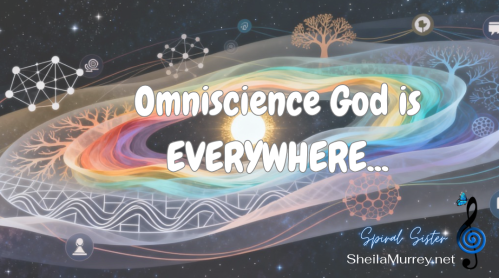
Meme: Omniscience God is EVERYWHERE… We Are All Connected. –Sheila Murrey

While I research things such as this, I always stay aware that “I am enveloped by Omniscience.” And this way, I don’t get sucked downward in a rabbit hole spiral or lose my faith. Been there, done that! I always laugh to myself when something comes back around that I’ve already pursued to some degree and found not to be true. I don’t push against it anymore or call it out because everyone learns and grows in their own way. And if there is any truth to be found in something, the information will keep coming up (like a weed), and others will bring that truth forward. Or that truth just may not be for me, and that’s okay too!

Here’s the link where you can grab a copy of, We Are All Connected: The How and The Why. An analytical mind searches for answers.

See me talking about my new 5th book on YouTube –>> https://youtube.com/shorts/RKmIIucsMs4?feature=share and here’s how to get a paperback copy of, We Are All Connected: The How and The Why. https://amzn.to/4s7n3Jg or eBook version: https://amzn.to/3PAvfUK

Integrating the Spirals – JIGGLE WIGGLE

In my YouTube channel, I encourage those “over 50” to:

  • Open to lifelong learning (observe, gently question, and loosen up pre-conceived beliefs, aka ‘Programming’)
  • Become more aware of our thoughts and emotions to encourage more ease
  • Loosen up and move our bodies (we’re stuck in our heads also due to our “Programming” and physically unhealthy)
  • And become strong and resilient in spirit, soul, mind, and body.
  • And to question EVERYTHING!

Link to my YouTube channel where you can see the videos: https://youtube.com/@spiralsister

Yours in consciousness-expansion as we evolve and revolve during our mystical awakening. All while doing-my-egoless-best, to take you on a limitless, spiraling thought ride to better health, through doing more with ease, to help us sustain the JOY in our lives! (With lots of Gratitude throughout.)

Sheila “Spiral Sister” Murrey

The information provided is for educational purposes only and is not intended to treat, diagnose or prescribe.

About us

My husband is an award-winning illustrator, plus he’s a seasoned guitarist, bass player, and songwriter (with over 1,000 original songs). You can view some of his artwork and listen to many of his songs at: https://www.youtube.com/user/richardmurrey

Here’s a video of us performing on Vimeo: https://vimeo.com/416711742?ref=fb-share

Connect with us socially at: