A dear friend of mine (and fellow blogger) who now lives in Thailand has been writing a series of blog articles that I want to draw attention to… you might also know she’s been my sketch teacher and weight loss/exercise motivator for the last couple of years as well. Linda Lewis.
As you know, I LOVE that Brian found a way to bridge Meditation and Thankfulness in this “5 minutes of Gratitude” type of practice. It’s really biblical too, when one thinks about it, as we’re admonished over and over again “not to worry” and to “trust in God.” So, this practice of Gratitude not only fits the Buddhist philosophy and spiritual take on things, but also the biblical perspective. I love it and want to promote it as well.
I had a statement (not a mental image) drop in during a meditation I was doing years ago and it was that “Everything Resolves to Gratitude.” Of course, THAT is harder to understand and “reach” as a place of knowing than it is said.
I get big topics like that when I meditate, which is why I don’t meditate daily anymore. Until the world is ready for me, well, hehe, a small fraction may only ever be, I will hold back. But I’m probably wrong and just tired after getting this last book out that still so few want. As for the “woo-woo” stuff, you know I love it and LIVE for the woo! I am soooo glad you got that mental image “drop in” of Harvey and Brian. The peace and comfort it gave you then, the tears were cleansing, is one that I do not believe will ever leave you. And that my dear friend WAS a metaphysical experience. Yay WOO!
Watch the last 20 minutes this
I was pleasantly surprised when after the 2 hour mark, https://youtu.be/ur_-7JONZlY?si=r-2mEVwO0o0lWK1G Tim Robbins shared a metaphysical experience of his with Joe Rogan and Joe didn’t try to debunk it! I won’t spoil it, but it’s REALLY good!!! I think it starts about 2.06:00 or 2.07:00; I did make a comment on the video and tried to mark it.
Proving the WOO
One of the readers of my latest book, We Are All Connected: The How and The Why, has told me and a Unity group he hosts that my book offers a thousand ways or more to prove the WOO exists and connects us all. It was a pretty big tell and my jaw actually dropped open when he proclaimed it. Thanks Andy. I believe very soon the connection between heaven and earth will make the WOO visible and quite undeniable to ALL. Til then, anyone who is interested can read my book.
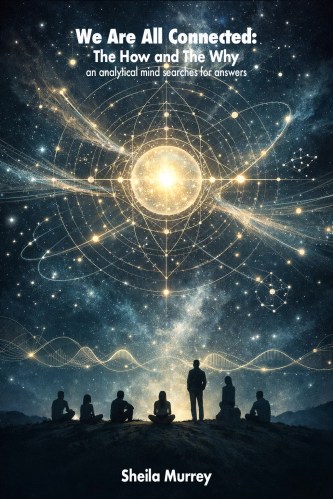
My book, We Are All Connected: The How and The Why
Find me over on my YouTube channel for JIGGLE WIGGLE, mobility movement videos, video book reviews, plants, art, and more at: https://youtube.com/@spiralsister
Yours in consciousness-expansion as we evolve and revolve during our mystical awakening. All while doing-my-egoless-best, to take you on a limitless, spiraling thought ride to better health, through doing more with ease, to help us sustain the JOY in our lives! (With lots of Gratitude throughout.)
Sheila “Spiral Sister” Murrey
The information provided is for educational purposes only and is not intended to treat, diagnose or prescribe.
About us
My husband is an award-winning illustrator, plus he’s a seasoned guitarist, bass player, and songwriter (with over 1,400 original songs). You can view some of his artwork and listen to many of his songs at: https://www.youtube.com/user/richardmurrey
During the Unity business group interview in July 2026, Sheila introduced herself by sharing a brief overview of her background. She is a mom, wife, grandmother of three, and has worked in a wide range of fields, including higher education, aviation, computer systems, admissions, business analysis, programming, systems analysis, and technical writing. Alongside that professional path, she has maintained a deep passion for holistic spirituality, Daoism, alternative health, energy medicine, and natural remedies.
She also enjoys singing and co-writing songs with her husband, who is a guitarist, bassist, and songwriter. Together they have created original work and videos for YouTube. Sheila has also written several books, which helped reconnect her with old friends and colleagues over the years.
The book, We Are All Connected: The How and The Why. An analytical mind searches for answers
The inspiration for the book, Sheila explained, came from a metaphysical experience in 2004. During the night, while on vacation and asleep beside her husband, she heard a deep male voice repeat the words, “We are all connected.” The phrase startled her because it was repeated twice, and she initially thought she might be dreaming. When she woke her husband, he told her she had probably just been dreaming, but the experience stayed with her.
From that moment on, Sheila said, her analytical mind took over. She began researching every possible angle surrounding the phrase: whether it was spiritual, psychological, or even some kind of unusual frequency or interference. Her background in electronics and radio made her think about signals, wavelengths, and transmission. Over time, her search expanded into deeper areas such as past-life regression, remote viewing, consciousness studies, and the work of the Monroe Institute.
She described the book as a wide-ranging exploration of connected consciousness. In Part One, she examines the origins of the idea, the unified field, the cosmos, the Earth, and the nature of frequency and physics. Her interest in these subjects was deepened by films like What the Bleep Do We Know? and by the work of thinkers such as Nassim Haramein.
Part Two focuses on life and the living matrix. Sheila said she has studied the work of Bruce Lipton, Joe Dispenza, and Greg Braden, and she regularly participates in a Zoom group with Bruce Lipton. In this section, she explores how the body’s cells respond to our thoughts and words, and how biology, the brain, mind, and consciousness all interact.
She also discussed spirituality, religion, philosophy, social structures, and technology. As a child, she used to wonder why different churches and religions seemed so divided, even when they all claimed a connection to God. That early curiosity shaped much of her later writing. She also includes discussion of the psyche, the afterlife, and the many ways human beings try to understand what lies beyond the physical world.
A major part of Sheila’s work has also involved grief, visitation, and experiences surrounding death. She volunteered with Dr. Raymond Moody, reading accounts of near-death and shared-death experiences sent in by others. This work deeply influenced her understanding of consciousness and survival after death. She also shared that she had personal experiences connected to the deaths of both of her parents, which further reinforced her sense that we are connected across different realms and states of being.
Sheila said that beyond the research to answer how and why those four words came to her, We Are All Connected (and everything that would become the book), she wanted to offer practical information. She included consciousness tools so that readers could apply the ideas in daily life rather than simply read about them. The book also covers more controversial subjects such as UFOs, secrets, cover-ups, and hidden forces, all framed within her larger theme of interconnectedness.
Dipping deeper
Sheila spoke about the role of ancestry and memory as well. Her mother had been a writer, though she was never published, and Sheila has continued working through her mother’s letters, notes, and ledger books. This process has been emotionally difficult, but it has also opened up new material and helped her move toward writing a screenplay. She hopes that even if she does not complete all of her creative goals in this lifetime, her grandchildren may one day continue the work.
Podcasting
When asked if she had ever considered podcasting, Sheila said she had thought about podcasting with her husband but did not yet have the equipment. One person suggested she appear on Next Level Soul, and Sheila appreciated the recommendation. Others present agreed that her work and perspective would fit well in that space. If you agree, please send comments to Next Level Soul that Sheila would make a great guest. Podcasters need to know people want to see the guests they bring on.
The host added that Sheila’s book was extremely comprehensive and that nearly every chapter connected some topic back to the central theme of human interconnectedness. He said that by the end of the book, a reader would come away strongly feeling that “we are all connected.”
Sheila agreed, saying that the book grew out of her own search for meaning. At first, she did not even think it would become a book. She simply wanted answers to the experience she had in 2004. She also said the work became more difficult because it was tied to personal and emotional material, including family relationships, childhood memories, and unresolved pain.
She spoke about how some people resist the idea of interconnectedness because they don’t want to be connected to certain kinds of people. For Sheila, that is part of why she believes she has been placed where she is now: to help repair relationships, soften judgment, and encourage people to see beyond division. She also discussed her background in West Virginia, her roots in American history, and her family connections to the Mayflower, the American Revolution, and the Daughters of the American Revolution.
Religious and spiritual themes
Her interest in religion and spirituality also comes from a lifelong habit of asking questions about why people believe different things. She said that after working for years in academic settings and technology, she learned the importance of context and audience. She wanted her books to cite sources carefully and give credit to the many researchers and teachers who influenced her.
She described herself as more of a bridge or connector than someone seeking attention or credit. Although she has been told she still has ego like everyone else, she said that for years she has tried to keep the focus on the information rather than on herself. She compared spiritual ideas to water: they must keep moving, connecting, and flowing, even if that means irritating people along the way.
She also described a program she created called Integrating the Spirals. In that work, she uses symbolic tools like a kaleidoscope and a mirror ball to help people look at their problems from different perspectives. The idea is that by turning the image, people can see new patterns, soften bias, and eventually expand awareness. In meditation, she said, one can go inside the mirror ball and become everything.
Choosing to believe in an afterlife
When asked which part of her research she loves most, Sheila said it is hard to choose because the topics are like children to her. Still, she admitted that her deepest interest is in God, omniscience, and spirituality. She said she has trouble relating to people who do not believe in some form of divine source or creator, though she recognizes that these are all belief systems.
She explained that she sees the unseen as just as real as the seen. While some people only accept what they can observe directly, Sheila believes that synchronicity, spirit, and invisible realities are central to understanding life. She also said that not everyone is ready for these ideas, and some people may need a future experience, or even another lifetime, before they can fully understand them.
The conversation shifted toward shared death experiences and the afterlife. Sheila explained that a shared death experience with her father met the parameters described by Dr. Raymond Moody, whereas the experience she had after her mother’s passing was more like a visitation. She said that these events helped shape her conviction that consciousness continues beyond physical life.
She also discussed the role of Christ, the cross, and religious symbolism in people’s lives. For some, these symbols function like a crutch or a structure that supports their spiritual identity. Sheila said she respects that, even if her own perspective is broader and more expansive. She believes that many spiritual experiences are interpreted through the lens of a person’s existing belief system.
In closing
The session closed with several participants thanking Sheila for her insights, her writing, and her openness. Many expressed interest in reading her book and exploring her blog further. Sheila thanked everyone warmly and said she appreciated the thoughtful conversation.
My book, We Are All Connected: The How and The Why
Find me over on my YouTube channel for JIGGLE WIGGLE, mobility movement videos, video book reviews, plants, art, and more at: https://youtube.com/@spiralsister
Yours in consciousness-expansion as we evolve and revolve during our mystical awakening. All while doing-my-egoless-best, to take you on a limitless, spiraling thought ride to better health, through doing more with ease, to help us sustain the JOY in our lives! (With lots of Gratitude throughout.)
Sheila “Spiral Sister” Murrey
The information provided is for educational purposes only and is not intended to treat, diagnose or prescribe.
About us
My husband is an award-winning illustrator, plus he’s a seasoned guitarist, bass player, and songwriter (with over 1,400 original songs). You can view some of his artwork and listen to many of his songs at: https://www.youtube.com/user/richardmurrey
 Integrating the Spirals